skip to main |
skip to sidebar
One of the aspects of graduate school I have most looked forward to is the opportunity to travel and experience new countries and cultures. This year during Berkeley’s winter break, I traveled to Peru. The highlight of my trip was a four day trek with 8 friends along the famed Inca Trail to Machu Picchu. I would like to share some of that experience with you here.
Day 1On the first day of the trek, we were picked up at 4:30 AM for a one and a half hour ride through a darkened Peruvian landscape to the town of Ollantaytambo in the Sacred Valley. Here we stopped for breakfast and to purchase any last supplies needed. After another 30 minute bus ride on a narrow dirt road, we reached our starting point. By 9 AM we had crossed through the government control check that limits trail hikers, including porters and guides, to 500 people each day. As clean, happy tourists, we posed for an enthusiastic photo at the beginning of our trek. Then we crossed the turbulent rapids of the Urambamba River on a rickety wooden bridge to start our journey in the footsteps of the Incas.
While we had been promised a morning of “Peruvian Flat” (i.e. rolling hills) the first hours of our hike seemed mostly uphill to me. My guidebook tells me that these first hours were spent in a sub-tropical ecosystem. The day was warm, and the land was more arid than I had imagined. I was surprised at the number of people living along the trail. Men walked the path with their llamas or donkeys, and children ran along the path watching the tourists. One group of children was even pretending to be tourists themselves. Apparently because it was summer in South America, the children were on their summer break. I’m not sure how much elevation we gained during the morning, but we were definitely going up.
In the morning we saw our first Inca ruins. Below us on the trail was the Inca storehouse of Llacapata. Grains and fruits from the sacred valley were brought here and stored for later distribution to settlements in the mountains.
We stopped for lunch at a campground called Wayllanbaba. Our guide told us that many groups took a short first day on the trail, and stopped here to camp for the night. By lunch, I wished we could stop for the night, but I would soon be grateful that we persevered. Because we went further than most groups did each day, I felt more isolated on the trail. I felt more a part of the beautiful Peruvian wilderness and the spectacular history of the trail than a tourist on a path well-traveled.
After lunch we faced stairs and more stairs as we gained 600 meters of elevation. The steep parts of the trail were lined with stone steps. I imagine that centuries ago these steps were smooth and level. With the passing of time however, the stones have become separated and uneven, making the trek more challenging than it may have been originally. At this higher elevation, the landscape became more tropical, and we entered a dense forest. Because the steep and winding path was surrounded by trees, it was impossible to see far ahead at the endless number of stone stairs to come. I was taken by surprise at a heard of llamas that came running down the path towards me, and quickly backed aside to let them pass.
Exhausted, I reached the first campsite at around 5:30 PM. My reward was a beautiful view of the Sacred Valley during and surrounding mountains during the remaining daylight. Our amazing chef prepared a delicious dinner for us, and food had never tasted so good to me. From the campground, I could hear rushing water from a nearby waterfall, and this was the sound that eventually lulled me to sleep.
Day 2On the morning of our second day, we faced another 600 meter elevation gain. The upside of all this climbing was spectacular views. Fog covered the valley in the morning. The trees were sparse during this part of the trek and each time I stopped for air, I could admire a spectacular view of mountains and valleys. The morning was hot and sunny, but shrubs provided some shade during water breaks.
Finally after approximately 2 hours of hiking, I reached the top of the trek’s highest pass. At 4,200 meters, it was hard to believe how far we had already come. My sense of victory was short-lived, however, as we spent the next few hours descending. All of that hard working climbing up seemed for nothing! The back-side of the mountain seemed like it received more rain, as there was more foliage and flowers. My favorite flowers were the lupines, clusters of small purple and white petals in a conical shape. Our very knowledgeable guide, Sol, also pointed out baby Falcons flying nearby.
After lunch we began climbing again. Half-way through our ascent we reached the ruins of Runkuraqay, which was a guard tower. From it we could see two ancient Inca trails, the one we were hiking and another, now overgrown. This strategic location also had a view of the pass on which we had recently stood. I could see the shadows of other hikers who had recently summitted.
We continued along the path to climb to the second-highest elevation of our hike at 3950 meters. We passed serene mountain lakes on our way up, and by then it was all I could do to keep from jumping in! The steep descent seemed even harder than the ascent. Descending on the uneven stone steps took great concentration and strength. Our guide, Sol, called this “meditation time” for internal contemplation. I saw even more flowers during this part of the hike, including the beautiful yellow lady slippers and the blue purple potato flowers.
Late in the day we reached, Sayamarka, which means “Inaccessible Place” in Quechua. To get to these ruins we climbed terrifyingly steep steps with no protection from falling off a cliff and into the forest below. This mountain community was a resting spot for travelers to Machu Picchu. Fog swirled around the neighboring mountains, adding to an air of mystery. Our guide showed us how water was channeled from nearby mountain springs to the complex of buildings and then circled around to provide water to all inhabitants.
During our final half hour of hiking we entered the cloud forest. Finally we reached our camp, which had views of snow-capped mountains. We celebrated our victory over the two challenging mountain passes with mad-libs and drinking games. But after we retired to our tents, a storm set in. Thunder and lightning kept waking me up each time I managed to fall asleep.
Day 3On day 3, I finally found the “Peruvian Flat” I was promised on Day 1. We had only 100 meters of uphill climb, followed my mostly flat land or rolling hills. The cloud forest reminded me of those I had seen in Costa Rica, lush and green. After about an hour it started to rain, and we all put on our ponchos. The uneven rocks, now slippery scared me, and I cautiously trailed the group. In some places, rivers of water ran over the path, making walking difficult. Every 10-15 minutes, I had to jump aside, to let the porters run by me. I was amazed with their ability, laden with heavy packs, to run over the wet stones without falling. On this part of the trek, the path was lined with ferns. Our guide pointed out several kinds of orchids, including the smallest variety in the world.
Before lunch we reached the third campsite at Winay Wayna. The agricultural ruins of Winay Wayna turned out to be my favorite of the trip. Archeologists identified these ruins as an agricultural site. A terraced fountain, still operating, delivered water to the agricultural terraces. Temples at the top of the mountain settlement provided a place of prayer. Houses were found at the very bottom, below the agricultural terraces. We first visited the site in the rain, then again at dusk when the rain had stopped. The ruins were nearly empty. One of the highlights of my trip was standing alone in an ancient home touching the stones of the walls and observing the beautiful mountain scenery around me.
I had been looking forward to a warm shower at the third campsite all day, but alas these were broken during our visit. Instead, my group enjoyed beers and wine to celebrate nearing the end of our trek.
Unfortunately, part of our campsite turned out to be downwind of the bathrooms…definitely not the Ritz! However, the night was still amazing. Two friends, Thomas and Bum Jo, and I spent part of the night admiring the stars. I couldn’t help but think how lucky I was to be able to experience this. The moon was nearly full, illuminating nearby mountains. The moonlight reflected off snow covered peaks and wispy clouds floating nearby them.
Day 4Day 4 was an early morning. We woke at 3:40, quickly packed and ate, to be in line at the final checkpoint at 4:30. At 5:30 we were allowed to pass through. Our guide estimated the walk to the Sun Gate at 1.5 hours, but we completed it in a speedy 50 minutes. (And as I was one of the slower ones of the group, some were even faster!) In the rush to the Sun Gate it was difficult to appreciate the scenery. However, at the Sun Gate we were rewarded with a beautiful day and our first view of Machu Picchu. After another 20 minute descent past some rather contented llamas, we reached the entrance to the park.
Machu Picchu was discovered by Hiram Bingham in 1911. The city was built around 1460 but abandoned less than 100 years later because of the threat posed by the invading Spanish armies. I found the sophisticated engineering of the site to be extremely interesting.- The location of the city guaranteed rain even in the dry season.
- A sophisticated drainage system in the agricultural terraces prevented the terraces from retaining too much water for the crops. Top soil from the sacred valley was placed in the agricultural terraces to increase agricultural yields.
- Structures were built with angular walls to prevent them from collapsing as a result of Peru’s frequent earthquakes. As a result of this ingenious design, the city still stands hundreds of years later.
- The builders of Machu Picchu incorporated existing stones into the architecture so that their buildings fit with the natural environment surrounding them.
- Different types of stone work were used for buildings of different purposes. Temples and holy sites were built using large stones, precisely carved and smoothed, that were placed on top of each other without mortar.
- In the areas where the nobility lived, doors locked from the inside for added protection and seclusion.
- One of the main temples receives the sun perfectly through its windows on Solstice days.
I also learned many interesting facts about the builders of this city throughout our trek:- First, Incas were the name of the ruling nobles. Quechua was the name of the civilization. Quechua people still live today. Quechua is a language that is still spoken. And Quechua symbols of religious significance are still worshiped by many Peruvians.
- The Quechua people worshipped three different levels of the world around them.
Heavens / the sky- symbolized by the condor Earth or Pacha Mama- symbolized by the puma Rivers and streams- Represented by the snake.- Quechua people also worshipped mountains. Machu Picchu is situated between holy mountains.
- Cusco was the capital of the Inca Empire, and the Supreme Inca lived in Cusco. At its peak the empire included not only Peru, but Ecuador, Bolivia, and Chile.
- The names of the Inca ruins I saw are not known. The names we call them today, including Machu Picchu, were given by modern “discoverers” and archeologists of the ruins.
- Pachacutec was the most powerful Supreme Inca. He expanded the Inca Empire during his reign, and it is now thought that Pachacutec commissioned the building of Machu Picchu.
It was amazing to walk through this historic city of Machu Picchu and reflect on the people who built it. The modern world could take lessons from their sophisticated means of agriculture, which fed their people sustainably. In addition, the builders of Machu Picchu understood environmental risks to their structures and engineered their cities accordingly. 500 years ago the Quechuas built a city that has withstood hundreds of earthquakes, something that modern countries repeatedly fail to do with devastating effects. What loss of life could be prevented if we took more construction lessons from Inca cities? Finally, I enjoyed the beauty of a city that seemed to emerge naturally out of the surrounding landscape. Maybe Frank Lloyd Wright was an Inca in a past life. It seems to me like this lost culture was in some ways more civilized than we “modern” people are today. The world has much to learn from its civilizations of the past.
During the Net Impact conference I attended a panel on Environmental Markets. The panel was of particular interest to me because some of the key ideas presented were in direct opposition to the thoughts of Hunter Lovins, a recent speaker at UC Berkeley’s Capitalism Next series. Hunter Lovins is a proponent of natural capitalism, the idea that as natural resources once considered nearly free become scarcer, for profit businesses should and will calculate the value of those resources as costs associated with their operations. She praised emerging environmental resource markets and a realization of her ideals. I was surprised, however, that she de-emphasized the role of government in inciting businesses to value natural resources. The Net Impact conference panel on environmental markets sought to explore why environmental commodities markets are emerging and what is driving companies to join them. In particular, given Ms. Lovin’s comments about the Chicago Climate Exchange (CCX), I was interested in hearing Megan Morgan from the CCX speak about its emergence.I should probably start with an overview of the Chicago Climate Exchange. CCX began in 2000 as a grant to Dr. Richard Sandor, an economist at the Kellogg School of Management, to assess the feasibility of a cap and trade market in the U.S. to reduce greenhouse gas emissions. CCX trading began in 2003 with 13 charter members that sign legally binding agreements to reduce greenhouse gas emissions. Organizations that reduce more than the requirement may trade credits for money to those organizations that do not. Today, 11% of Fortune 100 companies participate, and similar carbon trading market has also been launched in Europe.
Given Ms. Lovin’s belief that a change in government policy is not needed to spur creation of natural markets, I was quite surprised to discover that the panelists thought just the opposite. According to the Net Impact panelists, the sole emergence of the CCX is because companies are anticipating government regulation. They believe that joining a voluntary carbon market will give them a competitive edge once regulation is created. For example, 25% of the largest U.S. coal emitters participate in the CCX. Megan Morgan quoted a coal industry CEO as saying his company joined CCX because, “We want to have a seat at the table rather than being eaten for lunch.” Companies are joining the CCX because:
- Regulation of carbon is increasingly becoming part of a dialogue for U.S. politicians. If or when regulation is passed, participants feel they will have a competitive edge over peers who have not yet taken steps to reduce their carbon emissions.
- Europe has begun to tax polluters, and many U.S. executives prefer a cap and trade system that would financially reward companies that find innovative ways to cut carbon emissions. Voluntarily joining such a system is a way of demonstrating support for such a model and of influencing future legislation.
- Being unprepared once carbon regulation is passed will impact return to shareholders.
- The initial audit companies participate in after joining CCX causes many companies to identify energy saving opportunities that save them money.
So, it seems that contrary to Ms. Lovin's belief, our government does set the tone for when and how businesses will choose to confront climate change. We can see from the emergence of the CCX that even the threat of a cap and trade system can spur creativity. I look forward to seeing what policy the Obama administration will implement in the coming years, and I truly hope that it will incentivize U.S. companies to find new and creative ways to cut carbon emissions.
I haven't had much time to write lately, but today while reading a case about Federal Express for my marketing class, I came upon a great quote. Fedex was, as of the writing of this HBS case in 1983, the largest venture capital start-up in U.S. history with $90 Million in financing. The founder of FedEx, Frederick W. Smith Jr., said about the early financial difficulties of the company:
"The biggest asset we had going for us was our naivete. God takes care of fools, you know."
So that's my little tidbit of interest for this week.
In this entry I have two recent experiences to write about. This weekend I attended the Net Impact Conference in Philadelphia, PA. I had the opportunity to attend a variety of panels on topics ranging from microfinance to “greenwashing.” In addition, last week at Haas the Net Impact club hosted the second in our Capitalism Next Speaker series. The topic of the session was how private enterprise can sustainably fight poverty in emerging economies.
During these two events, I started thinking about sustainability in a new way. We hear a lot about how companies can make their products more sustainable by reducing packaging or using recycled materials. We also frequently hear about how homes and business can become more sustainable by using better insulation, adding more natural light, and using environmentally friendly materials. But we don’t often think about how aside from products and buildings, the structure of the organizations we create must be sustainable for them to truly succeed. Obviously with respect to the core operations of for-profit businesses this is intuitive. If a business consistently spends more money than it takes in, has trouble paying its suppliers, and treats its employees miserably, the business is likely on a fast road to failure. However, many organizations whose mission is to address poverty, whether the philanthropy arm of a large company or an independent non-profit, are recently realizing that creating a sustainable organizational model can drive extremely successful results. It’s the mentality of teaching a man to fish rather than giving him the fish to eat, so that he can feed himself after you row your boat off into the sunset. This week I have seen evidence that more and more organizations are developing innovative, creative, and sustainable models to address social problems.
On Saturday at Net Impact, I attended a session about measuring the business value of social impact led by Jason Saul, the founder of Mission Measurement. Mr. Saul consults with large companies that want to drive better results from their corporate philanthropy and social responsibility programs. The old way companies looked at these efforts was to do less bad (i.e. pollute less) and use their foundation to do good deeds that were generally unrelated to their profit making endeavors. The budget for these traditional corporate foundations could find themselves at the chopping block during challenging business environments. Such philanthropic efforts were not sustainable because at the end of the day they did not add business value. The emerging trend in CSR is to solve social problems by generating business value. Mr. Saul gave the example of Kraft Foods, which began issuing microloans to Latin American entrepreneurs to open small stores. These store owners then have the option of stocking Kraft products. The communities in Latin America win because new jobs are created. The entrepreneur and his family win because they achieve a higher standard of living. Finally, Kraft wins because they have created a new distribution channel in a region where they had not previously sold product. Responsibility programs that drive shareholder value will be more sustainable and less likely to face budget cuts. Why would Kraft cut their microloan program when it increases their revenues by opening a new market?
At Capitalism Next, I learned about how for-profit social ventures are creatively addressing poverty for the 72% of the world’s population with a total family income under $3,000 per year, also called the “bottom of the pyramid.” Katie Schmitz of water health international, a profit based organization that provides clean water for communities lacking access, made an interesting comment during the session. She said that the challenge with communities relying on the generosity of donations to meet basic needs is that funding levels are subject to fluctuations caused on philanthropic trends. As Africa has become the “it” region for philanthropists, developing nations in other regions of the world have seen money for their communities dry up. Profit based organizations that address poverty are more sustainable and can continue to meet the needs of the community when the non-profits shift their funds elsewhere. Families at the BOP are willing to buy clean water, and WHI has found a way to provide that water cheaply and profitably. With access to clean water, families then experience less illness. Since physical labor is the primary source of income for these families, good health increases earning capacity. Families win because they experience less illness and earn more money. WHI wins because it earns a small profit off the water it sells.
My last example strays a bit from the two above but was a trend I found very interesting. At Net Impact I attended a panel on the role for for-profit businesses in conflict regions. I learned that multi-national organizations operating in conflict regions are finding ways to make their business operations in those regions more sustainable. Generally companies building operations in conflict regions don’t intend to make the region more unstable. It is common for multi-nationals support programs to reduce poverty in those communities. However, as NI panelist, Melissa Powell from the UN Global Contract mentioned, “the road to hell is paved with good intentions.” To address this, the UN has developed a resources guide to teach multi-nationals how to improve their daily business operations in these countries. For example, the UN encourages the companies to create sustainable relationships with local communities and governments by partnering with them. In the past, some multi-nationals with good intentions built infrastructure for the community. But without government participation these institutions were susceptible to collapse, especially if the multi-national were to leave the region. It is far more sustainable to partner with the government so that the government will build schools, hospitals, and other infrastructure. Obviously most businesses operating in conflict zones are doing so for self-serving, rather than philanthropic reasons. Multinationals would not be operating in these regions if they did not have a powerful reason to do so, such as needing access to valuable natural resources. But bringing business operations to former conflict zones can be an effective way to grow the economies of those areas and promote stability if multinationals operate in a sustainable way.
I think it is wonderful that organizations are finding new, sustainable ways of addressing poverty. The creativity of the social entrepreneurs driving this change by founding their own organizations or by influencing the actions of existing organizations is truly inspirational to me. While I don’t believe that all poverty initiatives should be self-serving or generate a profit, and I definitely believe there is still an enormous role to be played by non-profit organizations helping our world’s poor, I find the growth of innovative approaches to addressing poverty to be an exciting phenomenon.
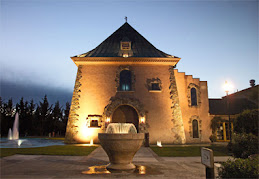
Last weekend, I toured two eco-friendly wineries in nearby Napa, California. From my blog entries you may have the impression that all I do is tour “green” businesses. Yes, I do attend actual classes here at UC Berkeley. But as my grade on the upcoming finance midterm is bound to demonstrate, I have definitely been taking advantage of the extra-curricular activities.We visited two wineries:- CADE is a new winery located in the Howell Mountain appellation of Napa. Still under construction, CADE has been open to visitors for just two months. The winery is being constructed with recycled materials including walls of fly ash “concrete,” denim insulation (recycled from old jeans), and recycled plastics that resemble wood. CADE is pursing LEED Gold certification for its buildings and is using sustainable farming methods in the production of its grapes.
- Founded in 1982, Peju is a familiar site along Napa’s highway 29. In 2006, Peju’s owners installed a 126 kW solar system on the roof of the winery. Peju prides itself on the organic and sustainable farming methods they use to grow and farm their grapes. Our tour at Peju was unique. After an overview of the winery and a tour of the grounds, the owner of Akeena solar, the company that installed Peju’s system, taught us about solar energy. Afterwards, Sara Fowler, Peju’s head wine maker gave us an overview of the organic farming methods used at Peju.
I want to reflect on two interesting themes I noticed during my winery visits.First, wineries face tradeoffs between the unique needs of their business and existing certification programs. In this way, the wine business is similar to the hospitality industry. During my visit to The Orchard Garden hotel, I noticed the tradeoffs between one person’s evaluation of what truly makes a product or service “green” versus the one-size-fits all recommendations of a certification board. While CADE and Peju are using organic and sustainable farming methods for their grapes, they are not producing organic wine. Sara Fowler from Peju explained that to have wine certified as organic, it must be produced without the use of sulfites. However, without this ingredient the wine simply isn’t high quality. Wineries aren’t willing to commit product suicide by compromising the quality expected by their customers in favor of eco-friendly production methods. As a result, they go down the path of sustainability, but not far enough for organic certification. Because ‘organic’ is not on the label, customers can’t distinguish between a winery that grows organic grapes and one that uses no organic farming techniques whatsoever. In my mind this raises a question: Should certification programs be developed that reflect the unique needs and constraints of different industries?
On the other hand, creating too many certification programs or bending the rules of a single certification program for different industries can be confusing and misleading for consumers. A great example of this is frozen meals that are certified organic under USDA guidelines. The frozen food industry successfully petitioned the USDA to allow it to include many non-organic chemicals and preservatives in their frozen meals. They claimed that without such chemicals they would not be able to produce organic frozen dinners at all. However, many consumers don’t realize that when they buy a frozen meal labeled “organic” they are purchasing many of the chemicals they probably hope to avoid. Plus it seems unfair to require the exclusion of certain chemicals in some organic products but not others.
A second theme was the carbon footprint implications of creating a new, “green” product versus using an existing, already manufactured product. I’ve read that when a family disposes of their Hummer to purchase a Prius, unless a new car was already needed, it takes 7 years of fuel-efficient Prius driving to equalize the carbon footprint caused by manufacturing the new car. Something similar could be claimed about solar panels. Solar manufacturers estimate that it takes between 4 and 7 years of operation to equalize the carbon footprint created by the manufacturing and distribution of the panels. However, I don’t think we should write off solar for several reasons. First, while it may take up to 7 years for solar panels to become carbon neutral, their expected lifespan is 25-35 years. Next and very important, panels on residences and business reduce demand on the power grid and even contribute more power to the grid. As the U.S. population grows demand for energy increases. Thus the footprint of solar installations can’t just be compared against the status quo but against the presumably very large carbon footprint of building new power plants to meet increased demand. Finally, in business school we learn about the experience curve. As companies produce greater cumulative volume of a product over time, the cost of making each unit decreases due to increased experience manufacturing, marketing, and distributing the product. I wonder if there is a similar carbon experience curve. As more solar panels are made and companies become more efficient at their production, the carbon impact of solar panels could decrease.
This week, I had the privilege of touring San Francisco’s Orchard Garden hotel, California’s first LEED certified hotel. Leading our tour was General Manager, Stefan Muhle, who has been active with the property since conception. Comparing Orchard Garden to Arterra, the LEED certified condo development I toured several weeks ago; there were both similarities and differences. Obviously, being a hotel, the builders and managers of Orchard Garden face some unique challenges. However, there were two striking similarities. First, similar to the low expense of LEED certification at Arterra, building to LEED standards cost only $100,000 extra on a project totaling $21 Million. Secondly, though marketing the property as a green hotel gives it a competitive advantage in terms of increased publicity and high occupancy rates soon after the hotel opened, Orchard Garden is not able to charge a premium for each room.
Designing and operating an eco-friendly hotel involves tradeoffs. As Mr. Muhle walked us through the hotel, it became evident to me that he faced many tradeoffs between the requirements of official certification programs and his own judgment of green products and services. Certification rules and guidelines do not always guarantee a product or service is actually the best environmental choice. While some products or service providers may have met the requirements of certification programs, the OG team often decided the requirements were not enough, and went further to be more ‘green.’ There is a difference between being green on paper and green in spirit. Some examples:- The Orchard Garden team wanted their restaurant to represent the ‘green’ ideals of the hotel. One way to do this would be to serve only foods certified as organic. However, Mr. Muhle and team determined that it was more important to serve local, in-season food, and after those requirements are met, serve organic food when possible. Many local farmers grow food that is pesticide free, however due to the effort and expense required to pursue organic certification, the growers do not do so. Thus, the OG team is using their own discretion to determine what it means for food to be ‘green’ rather than strictly following guidelines set out by organic food certification organizations.
- Green Seal encourages hotels to use environmentally friendly detergent for their laundry. However, the nearest such provider was extremely far from the hotel. The OG team determined it was decidedly not green to truck their laundry so far each day. Consequently, they partnered with a nearby vendor that agreed to change detergent for the Orchard Garden. By using the first vendor, the OG may have technically met the requirement for green certification, but it was their personal initiative that really 'greened' the hotel.
- Mr. Muhle and the Orchard Garden team had to decide how to ‘green’ the toiletries hotels provide to the guests. Green Seal encourages hotels to use mass dispensers, which do not maintain the image of a high-end hotel. Mr. Muhle also explored compostable containers out of corn, but the team decided that it was not green to use corn in packaging when so many people lack sufficient food. Finally, they identified a local manufacturer of shower products that worked with Orchard Garden to create a 360 recycling program for the bottles.
The owners, architects, and operators of the Orchard Garden also had to make tradeoffs because of the cost, quality, and availability of sustainable materials. For example:- Existing sustainable wallpaper was not washable. Because guests often scuff the wall with their suitcases, it is critical that hotel staff be able to wash the wallpaper to maintain the hotel appearance.
- Organic cotton sheets are not durable enough to withstand commercial use. Mr. Muhle has continued to test new brands of sheets, including those containing bamboo, without success.
- The team had wanted to place solar panels on the roof; however, the roof was too small to accommodate solar panels in addition to the generator, chiller, and everything else needed there.
Other sustainable elements of the hotel included:- The hotel has European key card systems, where after opening the door, guests must insert the key card into a special slot to activate the lighting. When guests leave, because they must take the key, electricity is automatically turned off.
- Partitioned waste paper baskets in room allow guests to recycle their waste. These are not currently available commercially so the Orchard Garden team designed their own small, three section waste baskets, with separate bins for paper, bottles, and non-recyclable trash.
- All wood used in building materials and furniture is Forest Stewardship Council certified.
- Curtains, cover-lets and other in-room fabrics are machine washable to avoid the chemical-laden dry cleaning process.
- Carpets are made from recycled materials.
- Citrus based cleaners are used by the housekeeping staff.
- Recycled toilet paper.
- Each guest room contains vents to supply fresh air to room the room since San Francisco building codes require that windows be sealed.
- VOC free paint used throughout the hotel.
- CFC and LED lighting
Another challenge the OG team faces is measuring the success of the hotel in reducing its environmental impact. While some metrics exist and are very useful, others are lacking. For example, OG management measures the electricity saved due to the green hotel design and energy saving features. OG Managers also measure the amount of garbage diverted from landfills due to their recycling measures. However, some ‘green’ benefits are more difficult to measure. For example, staff receives PTO rather than dedicated sick days, so it is difficult to tell if employees experience less illness by cleaning with organic products.
Some good news is that environmentally friendly products and building materials have improved in selection, availability, and quality in the two years since the hotel was built. Because the Orchard Garden team is committed to being ‘green’ both in spirit and on paper, they continue to evaluate these new products for use in the hotel. For example, when a better shower head system was introduced, Mr. Muhle upgraded all of the showers in the hotel. I was truly impressed with the dedication of the owners, builders, and management of the Orchard Garden to environmentally friendly practices. The Orchard Garden is a beautiful hotel and the guest rooms are extremely serene. I would be thrilled to stay in a hotel such as this one!
Here are some links if you want to learn more about the hotel, Green Seal, or LEED:
http://www.theorchardgardenhotel.com/
http://www.greenseal.org/programs/lodging_projects.cfm
http://www.usgbc.org/DisplayPage.aspx?CategoryID=19
This week, Michael Callen, CEO of Amcap, a financial services company headquartered in NYC, spoke at Haas about the financial crisis. I can't do justice to his entire speech in this blog, but I did want to comment on one point he made toward the end. Mr. Callen spoke about government regulation, a theme touched upon by many recent speakers at Haas. What I found striking was that even in light of the tremendous loss of wealth and jobs over the past few months, Mr. Callen was adamant that government regulation is not needed.
Mr. Callen said, "Regulators will not be capable of doing anything but stultifying innovation in the name of safety." He went on to say that he has never seen regulation be effective, and "markets get it wrong, but they correct. Regulation is very slow to change."
Of course like any speaker, Michael Callen comes with a personal bias. As CEO of a financial services company, Mr. Callen could experience personal financial gain or loss depending on goverment's policies. However, he does have a valid point about government regulation's speed to change. In corporate America, I wasn't elected to my position, and the number of people I had to influence to make change was relatively small. Even in my role as a business analyst, the choices I made and the decisions I helped to facilitate could influence big dollars on the bottom or the top line. My job often required convincing my business partners to change their processes in response to new business realities. Unlike a politician, my arguments for change were not reduced to sound bites. Often I feel like politicians who recognize that an existing policy has good intentions but needs to evolve to be effective have a difficult time doing so because their aims can be distorted. Suddenly the politician with good intentions and great ideas is against children, the economy, the environment, Joe the Plumber, or American manufacturing. And who would re-elect a politician who doesn't stand for our children? It is difficult to change a law from good to better or to update a law that was good in the past but needs to evolve to be effective.
Our government failed to recognize the threat presented by CDOs, highly leveraged banks, and non-traditional bank activities. How could we regulate to prevent a threat we didn't even see? Now that the crisis has occurred, I agree with Mr. Callen that to some extent the market will self-regulate. Each financial institution will seek to minimize its own exposure to such risks in the future. However, I disagree with Mr. Callen that no regulation is needed. In my mind, perhaps the role of government should be to better facilitate this self-regulation by requiring more transparency.
Regardless of what policy is implemented, in 18 months I need another job, and thanks to a pricey business school education, I will have some big loans to pay. My fingers are crossed that the economy turns around by then!







 Posts
Posts

